

Public Health Explainer: The Hidden Networks Behind How College Is Built to Spread Disease
College campuses are not just communities, but dense social networks where shared classes, social groups, housing, and behaviors create predictable pathways for infectious diseases to spread. Research shows that structures like large general-education classes, tightly connected athletic teams, dorm living patterns, and student behaviors such as attending events while sick all shape how illnesses move through campus populations. Understanding these hidden network dynamics can help students make smarter choices to reduce risk while still participating in campus life.
You're not sick because you're gross.
It’s week four of the semester. Half of the lecture hall sounds like they caught the flu. Someone behind you is coughing throughout the entire presentation. Worse, you’re starting to feel a scratch at the back of your throat, too. You blame the usual suspects: lack of sleep, poor diet, and that one friend that definitely doesn’t wash their hands.
But according to recent research, while hygiene does matter, it’s not the main reason college students get sick. The real culprit is the organizational structure of the school: shared classes, social clusters, housing patterns, and behavioral norms enable diseases to spread easily across campus populations.
College campuses aren’t just communities — they’re dense social networks. Think tightly clustered friend groups connected by a handful of massive, high-traffic bridges. And those bridges? You sit in them three times a week. Even perfect handwashing cannot fully counteract the structural force of densely connected social networks. On a campus this connected, disease actually doesn’t spread randomly––it spreads predictably. Let’s look at five surprising ways network science explains how diseases spread on-campus and the hidden architecture that actually gets you sick.
Plot Twist #1: Blame Your Gen-Ed Requirements, Not Your Friends
Imagine that you’re a film major who only hangs out with other film majors. While you might be quick to assume that this insulates you from the frat flu tearing through the business school, research shows that your major doesn’t protect you, because your required “Calculus” class completely shatters that bubble. Course enrollments in general-education classes create “small-world networks” characterized by high clustering, short average path lengths, and multiple independent paths connecting students (Weeden & Cornwell, 2020). In other words, even in a university of 20,000 people where it might seem like your chances of crossing paths with the one person who brought a virus back to campus is low, thanks to your class schedule everyone is only mathematically two or three handshakes away from everyone else.
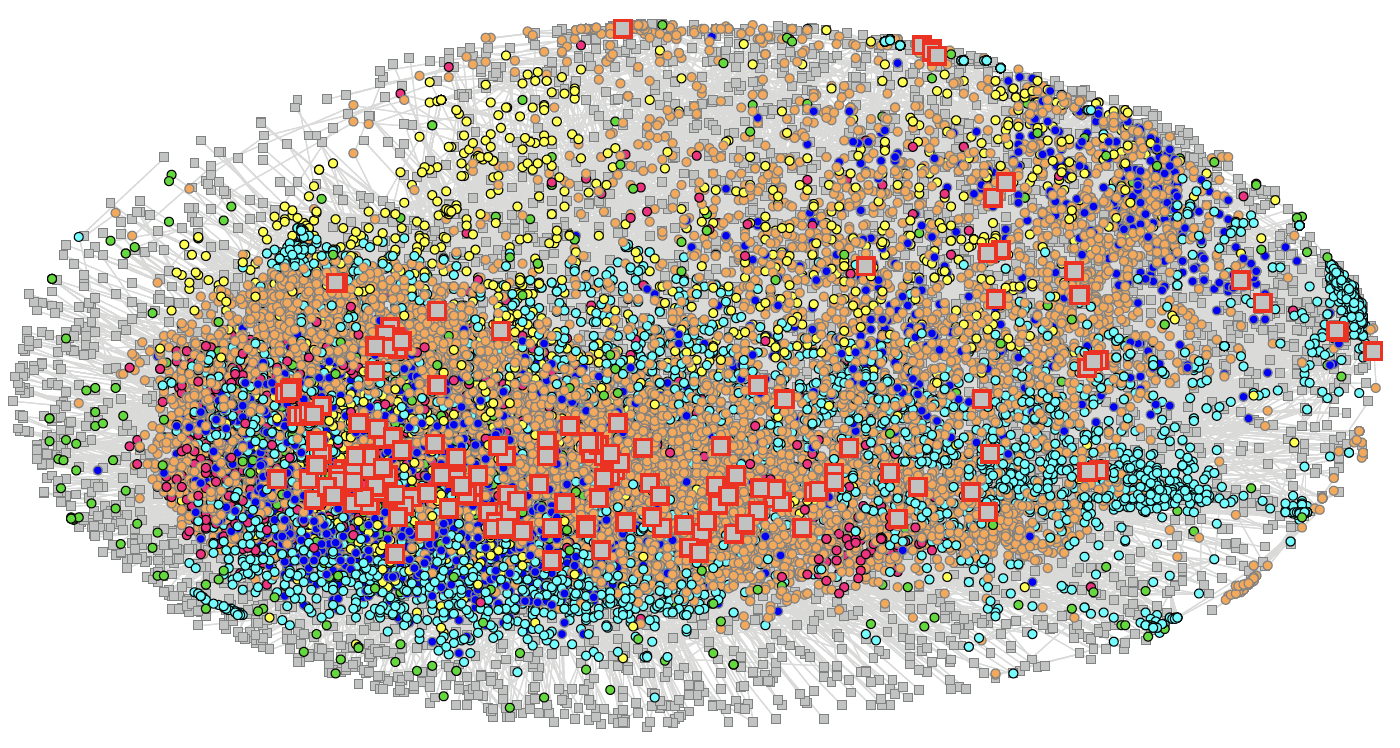
Figure 1. University Network (Weeden & Cornwell, 2020). Light gray squares represent courses, and larger gray squares with red borders indicate courses with 100 students or more enrolled. The small colored circles represent students and their majors: yellow: humanities, arts, and design; dark blue: social sciences; orange: STEM; red: multidisciplinary/mixed; green: undeclared; light blue: business and law. Students’ enrollment in particular courses is indicated with light gray lines.
In this diagram of a real university network (Cornell University’s Fall 2019 semester), this theory is easy to see; rather than each colored major being off on their own different sides as one might imagine, the campus is highly interconnected regardless of discipline. Even people who are on the far sides of the campus network may be only two or three large classes (grey boxes with red outlines) from someone on the completely opposite side. Where academic schedules connect the entire campus network, other social structures create even tighter clusters where diseases spread rapidly. One of the most striking examples is sports teams.
Plot Twist #2: The Athlete Paradox: It’s the Bubble, Not the Sweat
Tackling. Guarding. Breathing heavily on each other. At first glance, it would seem that so-called high-contact sports (think tackle football, wrestling, rugby) would be the reason why athletes are more at risk of getting sick during their athletic season. However, it has been shown that the actual sport being played rarely matters. Golfers are just as much at risk as wrestlers.
According to an article published in 2021 at the International Journal of Environmental Research and Public Health, athletic teams designated as high-risk for Covid-19 had an average incidence of 14.3 cases per 100 people, which was similar to 14.9 cases per 100 people in the low and intermediate risk athletic teams (Hertel et al., 2021). It turns out that it’s the off-field social network driving the spread of disease, not the physical contact of the sport itself. Student teams are incredibly close social groups that spend time together outside of practice and often live together, which is part of why researchers found student-athletes of any sport to be nearly five times more likely to contract an infectious virus like Covid-19 compared with non-athletes (Hertel et al., 2021). Athletes see each other repeatedly throughout the week, form overlapping friend groups, and travel to highly attended events together. Due to these factors, sports teams quickly form a bubble within the school network, meaning that any infection within the bubble is likely to immediately spread throughout it, no matter what sport is being played.
Plot Twist #3: Dorms are Viral “Black Holes,” Not Factories
It’s not unreasonable to believe that dirty and crowded college dorms brew diseases and spread them out to the rest of the campus and surrounding city. But according to recent research in the Public Library of Science’s Pathogens journal, dorms are actually viral dead ends which scientists call “phylodynamic sinks,” areas where a virus can circulate internally but rarely can escape to spread outwardly to other groups. In the study, testing showed that while outbreaks from off-campus housing consistently later created on-campus dormitory outbreaks, the virus almost never moved the other way from on-campus dorms to off-campus housing (Bolanos et al., 2025). This is due to the fact that your dorm isn’t a factory pumping out the plague but rather a trap where the virus circulates internally after being brought in from off-campus events. What does this mean for students living in dorms? Researchers aren’t sure. In the article, they stressed that their findings “raise the possibility that on-campus residences may be more vulnerable than often considered, functioning as epidemiological ‘islands’ that primarily receive infections from off-campus sources,” and that further research will be required in the future (Bolanos et al., 2025). So if viruses enter dorms and quickly spread throughout, how might leaving campus to travel affect disease spread?
Plot Twist #4: The Weekend Travel Paradox
While some students are scared of traveling and going out on the weekends for fear of being exposed to more people and therefore getting sick, it turns out that escaping the campus bubble may actually protect you. In a study of fall 2021 flu outbreaks at the University of Michigan, odds of influenza were lower for people who left campus for at least one day during the week before getting tested (Lewis et al., 2023). In other words, leaving the ultra-dense campus network works to break your link in the chain of transmission––the university campus is so dense that staying put means constant exposure to the networks that easily spread infections daily. Additionally, the researchers pointed out that “almost all early cases reported attending large events,” indicating that a short trip away from campus to a lower risk destination may help avoid the large campus gatherings that create outbreaks and break your link in the campus transmission chain (Lewis et al., 2023). Considering a visit home with family, a road trip to experience nature, or even a shopping trip off-campus may protect you from campus outbreaks.

Plot Twist #5: The FOMO Factor
We’ve all seen it: “If I wake up with a scratchy throat, I can just take some medicine and rally for the party. It’s just a cold, no big deal.” Research shows that a decision to “rally” may be the exact psychological engine that powers a university outbreak. It’s not just that viruses are contagious; it’s that young adults are statistically less likely to behave in ways that prevent the spread of infectious diseases compared to other age groups (Lewis et al., 2023). In public health, this is called the Health Belief Model: because most students are young and healthy, they likely don’t fear severe consequences. Therefore, the social reward of not missing out completely overrides the logical public health advice to stay in bed. Since increased risk-taking, social experience-seeking, and less thought for consequences are all common characteristics of typical young adults, students are more likely to attend events and not wear masks even when sick (Lewis et al., 2023). This urge for experience-seeking turns a healthy population into ideal transmitters of disease.
Beating the Math
The irony of campus life is that these same “small world networks” that create intellectually and socially vibrant campus experiences for students also make them ideal environments for infectious diseases. Each of these patterns––from Gen-Ed classes to athletic teams and weekend travel––reflects the same underlying reality: disease spreads through networks, and universities are some of the most densely interconnected social systems in modern society. Understanding these invisible structures doesn’t eliminate the risk, but it helps students make smarter choices about how they move through the network and protect themselves. By washing your hands, getting your vaccines, wearing masks when sick, and maybe even taking an occasional weekend getaway from campus, students can enjoy their campus experience to the fullest while staying healthy.
Video below:
More to Discover

Public Health Explainer: The Hidden Networks Behind How College Is Built to Spread Disease
College campuses are not just communities, but dense social networks where shared classes, social groups, housing, and behaviors create predictable pathways for infectious diseases to spread. Research shows that structures like large general-education classes, tightly connected athletic teams, dorm living patterns, and student behaviors such as attending events while sick all shape how illnesses move through campus populations. Understanding these hidden network dynamics can help students make smarter choices to reduce risk while still participating in campus life.
You're not sick because you're gross.
It’s week four of the semester. Half of the lecture hall sounds like they caught the flu. Someone behind you is coughing throughout the entire presentation. Worse, you’re starting to feel a scratch at the back of your throat, too. You blame the usual suspects: lack of sleep, poor diet, and that one friend that definitely doesn’t wash their hands.
But according to recent research, while hygiene does matter, it’s not the main reason college students get sick. The real culprit is the organizational structure of the school: shared classes, social clusters, housing patterns, and behavioral norms enable diseases to spread easily across campus populations.
College campuses aren’t just communities — they’re dense social networks. Think tightly clustered friend groups connected by a handful of massive, high-traffic bridges. And those bridges? You sit in them three times a week. Even perfect handwashing cannot fully counteract the structural force of densely connected social networks. On a campus this connected, disease actually doesn’t spread randomly––it spreads predictably. Let’s look at five surprising ways network science explains how diseases spread on-campus and the hidden architecture that actually gets you sick.
Plot Twist #1: Blame Your Gen-Ed Requirements, Not Your Friends
Imagine that you’re a film major who only hangs out with other film majors. While you might be quick to assume that this insulates you from the frat flu tearing through the business school, research shows that your major doesn’t protect you, because your required “Calculus” class completely shatters that bubble. Course enrollments in general-education classes create “small-world networks” characterized by high clustering, short average path lengths, and multiple independent paths connecting students (Weeden & Cornwell, 2020). In other words, even in a university of 20,000 people where it might seem like your chances of crossing paths with the one person who brought a virus back to campus is low, thanks to your class schedule everyone is only mathematically two or three handshakes away from everyone else.
Figure 1. University Network (Weeden & Cornwell, 2020). Light gray squares represent courses, and larger gray squares with red borders indicate courses with 100 students or more enrolled. The small colored circles represent students and their majors: yellow: humanities, arts, and design; dark blue: social sciences; orange: STEM; red: multidisciplinary/mixed; green: undeclared; light blue: business and law. Students’ enrollment in particular courses is indicated with light gray lines.
In this diagram of a real university network (Cornell University’s Fall 2019 semester), this theory is easy to see; rather than each colored major being off on their own different sides as one might imagine, the campus is highly interconnected regardless of discipline. Even people who are on the far sides of the campus network may be only two or three large classes (grey boxes with red outlines) from someone on the completely opposite side. Where academic schedules connect the entire campus network, other social structures create even tighter clusters where diseases spread rapidly. One of the most striking examples is sports teams.
Plot Twist #2: The Athlete Paradox: It’s the Bubble, Not the Sweat
Tackling. Guarding. Breathing heavily on each other. At first glance, it would seem that so-called high-contact sports (think tackle football, wrestling, rugby) would be the reason why athletes are more at risk of getting sick during their athletic season. However, it has been shown that the actual sport being played rarely matters. Golfers are just as much at risk as wrestlers.
According to an article published in 2021 at the International Journal of Environmental Research and Public Health, athletic teams designated as high-risk for Covid-19 had an average incidence of 14.3 cases per 100 people, which was similar to 14.9 cases per 100 people in the low and intermediate risk athletic teams (Hertel et al., 2021). It turns out that it’s the off-field social network driving the spread of disease, not the physical contact of the sport itself. Student teams are incredibly close social groups that spend time together outside of practice and often live together, which is part of why researchers found student-athletes of any sport to be nearly five times more likely to contract an infectious virus like Covid-19 compared with non-athletes (Hertel et al., 2021). Athletes see each other repeatedly throughout the week, form overlapping friend groups, and travel to highly attended events together. Due to these factors, sports teams quickly form a bubble within the school network, meaning that any infection within the bubble is likely to immediately spread throughout it, no matter what sport is being played.
Plot Twist #3: Dorms are Viral “Black Holes,” Not Factories
It’s not unreasonable to believe that dirty and crowded college dorms brew diseases and spread them out to the rest of the campus and surrounding city. But according to recent research in the Public Library of Science’s Pathogens journal, dorms are actually viral dead ends which scientists call “phylodynamic sinks,” areas where a virus can circulate internally but rarely can escape to spread outwardly to other groups. In the study, testing showed that while outbreaks from off-campus housing consistently later created on-campus dormitory outbreaks, the virus almost never moved the other way from on-campus dorms to off-campus housing (Bolanos et al., 2025). This is due to the fact that your dorm isn’t a factory pumping out the plague but rather a trap where the virus circulates internally after being brought in from off-campus events. What does this mean for students living in dorms? Researchers aren’t sure. In the article, they stressed that their findings “raise the possibility that on-campus residences may be more vulnerable than often considered, functioning as epidemiological ‘islands’ that primarily receive infections from off-campus sources,” and that further research will be required in the future (Bolanos et al., 2025). So if viruses enter dorms and quickly spread throughout, how might leaving campus to travel affect disease spread?
Plot Twist #4: The Weekend Travel Paradox
While some students are scared of traveling and going out on the weekends for fear of being exposed to more people and therefore getting sick, it turns out that escaping the campus bubble may actually protect you. In a study of fall 2021 flu outbreaks at the University of Michigan, odds of influenza were lower for people who left campus for at least one day during the week before getting tested (Lewis et al., 2023). In other words, leaving the ultra-dense campus network works to break your link in the chain of transmission––the university campus is so dense that staying put means constant exposure to the networks that easily spread infections daily. Additionally, the researchers pointed out that “almost all early cases reported attending large events,” indicating that a short trip away from campus to a lower risk destination may help avoid the large campus gatherings that create outbreaks and break your link in the campus transmission chain (Lewis et al., 2023). Considering a visit home with family, a road trip to experience nature, or even a shopping trip off-campus may protect you from campus outbreaks.
Plot Twist #5: The FOMO Factor
We’ve all seen it: “If I wake up with a scratchy throat, I can just take some medicine and rally for the party. It’s just a cold, no big deal.” Research shows that a decision to “rally” may be the exact psychological engine that powers a university outbreak. It’s not just that viruses are contagious; it’s that young adults are statistically less likely to behave in ways that prevent the spread of infectious diseases compared to other age groups (Lewis et al., 2023). In public health, this is called the Health Belief Model: because most students are young and healthy, they likely don’t fear severe consequences. Therefore, the social reward of not missing out completely overrides the logical public health advice to stay in bed. Since increased risk-taking, social experience-seeking, and less thought for consequences are all common characteristics of typical young adults, students are more likely to attend events and not wear masks even when sick (Lewis et al., 2023). This urge for experience-seeking turns a healthy population into ideal transmitters of disease.
Beating the Math
The irony of campus life is that these same “small world networks” that create intellectually and socially vibrant campus experiences for students also make them ideal environments for infectious diseases. Each of these patterns––from Gen-Ed classes to athletic teams and weekend travel––reflects the same underlying reality: disease spreads through networks, and universities are some of the most densely interconnected social systems in modern society. Understanding these invisible structures doesn’t eliminate the risk, but it helps students make smarter choices about how they move through the network and protect themselves. By washing your hands, getting your vaccines, wearing masks when sick, and maybe even taking an occasional weekend getaway from campus, students can enjoy their campus experience to the fullest while staying healthy.
Video below:
More to Discover
Public Health Explainer: The Hidden Networks Behind How College Is Built to Spread Disease
College campuses are not just communities, but dense social networks where shared classes, social groups, housing, and behaviors create predictable pathways for infectious diseases to spread. Research shows that structures like large general-education classes, tightly connected athletic teams, dorm living patterns, and student behaviors such as attending events while sick all shape how illnesses move through campus populations. Understanding these hidden network dynamics can help students make smarter choices to reduce risk while still participating in campus life.
You're not sick because you're gross.
It’s week four of the semester. Half of the lecture hall sounds like they caught the flu. Someone behind you is coughing throughout the entire presentation. Worse, you’re starting to feel a scratch at the back of your throat, too. You blame the usual suspects: lack of sleep, poor diet, and that one friend that definitely doesn’t wash their hands.
But according to recent research, while hygiene does matter, it’s not the main reason college students get sick. The real culprit is the organizational structure of the school: shared classes, social clusters, housing patterns, and behavioral norms enable diseases to spread easily across campus populations.
College campuses aren’t just communities — they’re dense social networks. Think tightly clustered friend groups connected by a handful of massive, high-traffic bridges. And those bridges? You sit in them three times a week. Even perfect handwashing cannot fully counteract the structural force of densely connected social networks. On a campus this connected, disease actually doesn’t spread randomly––it spreads predictably. Let’s look at five surprising ways network science explains how diseases spread on-campus and the hidden architecture that actually gets you sick.
Plot Twist #1: Blame Your Gen-Ed Requirements, Not Your Friends
Imagine that you’re a film major who only hangs out with other film majors. While you might be quick to assume that this insulates you from the frat flu tearing through the business school, research shows that your major doesn’t protect you, because your required “Calculus” class completely shatters that bubble. Course enrollments in general-education classes create “small-world networks” characterized by high clustering, short average path lengths, and multiple independent paths connecting students (Weeden & Cornwell, 2020). In other words, even in a university of 20,000 people where it might seem like your chances of crossing paths with the one person who brought a virus back to campus is low, thanks to your class schedule everyone is only mathematically two or three handshakes away from everyone else.
Figure 1. University Network (Weeden & Cornwell, 2020). Light gray squares represent courses, and larger gray squares with red borders indicate courses with 100 students or more enrolled. The small colored circles represent students and their majors: yellow: humanities, arts, and design; dark blue: social sciences; orange: STEM; red: multidisciplinary/mixed; green: undeclared; light blue: business and law. Students’ enrollment in particular courses is indicated with light gray lines.
In this diagram of a real university network (Cornell University’s Fall 2019 semester), this theory is easy to see; rather than each colored major being off on their own different sides as one might imagine, the campus is highly interconnected regardless of discipline. Even people who are on the far sides of the campus network may be only two or three large classes (grey boxes with red outlines) from someone on the completely opposite side. Where academic schedules connect the entire campus network, other social structures create even tighter clusters where diseases spread rapidly. One of the most striking examples is sports teams.
Plot Twist #2: The Athlete Paradox: It’s the Bubble, Not the Sweat
Tackling. Guarding. Breathing heavily on each other. At first glance, it would seem that so-called high-contact sports (think tackle football, wrestling, rugby) would be the reason why athletes are more at risk of getting sick during their athletic season. However, it has been shown that the actual sport being played rarely matters. Golfers are just as much at risk as wrestlers.
According to an article published in 2021 at the International Journal of Environmental Research and Public Health, athletic teams designated as high-risk for Covid-19 had an average incidence of 14.3 cases per 100 people, which was similar to 14.9 cases per 100 people in the low and intermediate risk athletic teams (Hertel et al., 2021). It turns out that it’s the off-field social network driving the spread of disease, not the physical contact of the sport itself. Student teams are incredibly close social groups that spend time together outside of practice and often live together, which is part of why researchers found student-athletes of any sport to be nearly five times more likely to contract an infectious virus like Covid-19 compared with non-athletes (Hertel et al., 2021). Athletes see each other repeatedly throughout the week, form overlapping friend groups, and travel to highly attended events together. Due to these factors, sports teams quickly form a bubble within the school network, meaning that any infection within the bubble is likely to immediately spread throughout it, no matter what sport is being played.
Plot Twist #3: Dorms are Viral “Black Holes,” Not Factories
It’s not unreasonable to believe that dirty and crowded college dorms brew diseases and spread them out to the rest of the campus and surrounding city. But according to recent research in the Public Library of Science’s Pathogens journal, dorms are actually viral dead ends which scientists call “phylodynamic sinks,” areas where a virus can circulate internally but rarely can escape to spread outwardly to other groups. In the study, testing showed that while outbreaks from off-campus housing consistently later created on-campus dormitory outbreaks, the virus almost never moved the other way from on-campus dorms to off-campus housing (Bolanos et al., 2025). This is due to the fact that your dorm isn’t a factory pumping out the plague but rather a trap where the virus circulates internally after being brought in from off-campus events. What does this mean for students living in dorms? Researchers aren’t sure. In the article, they stressed that their findings “raise the possibility that on-campus residences may be more vulnerable than often considered, functioning as epidemiological ‘islands’ that primarily receive infections from off-campus sources,” and that further research will be required in the future (Bolanos et al., 2025). So if viruses enter dorms and quickly spread throughout, how might leaving campus to travel affect disease spread?
Plot Twist #4: The Weekend Travel Paradox
While some students are scared of traveling and going out on the weekends for fear of being exposed to more people and therefore getting sick, it turns out that escaping the campus bubble may actually protect you. In a study of fall 2021 flu outbreaks at the University of Michigan, odds of influenza were lower for people who left campus for at least one day during the week before getting tested (Lewis et al., 2023). In other words, leaving the ultra-dense campus network works to break your link in the chain of transmission––the university campus is so dense that staying put means constant exposure to the networks that easily spread infections daily. Additionally, the researchers pointed out that “almost all early cases reported attending large events,” indicating that a short trip away from campus to a lower risk destination may help avoid the large campus gatherings that create outbreaks and break your link in the campus transmission chain (Lewis et al., 2023). Considering a visit home with family, a road trip to experience nature, or even a shopping trip off-campus may protect you from campus outbreaks.
Plot Twist #5: The FOMO Factor
We’ve all seen it: “If I wake up with a scratchy throat, I can just take some medicine and rally for the party. It’s just a cold, no big deal.” Research shows that a decision to “rally” may be the exact psychological engine that powers a university outbreak. It’s not just that viruses are contagious; it’s that young adults are statistically less likely to behave in ways that prevent the spread of infectious diseases compared to other age groups (Lewis et al., 2023). In public health, this is called the Health Belief Model: because most students are young and healthy, they likely don’t fear severe consequences. Therefore, the social reward of not missing out completely overrides the logical public health advice to stay in bed. Since increased risk-taking, social experience-seeking, and less thought for consequences are all common characteristics of typical young adults, students are more likely to attend events and not wear masks even when sick (Lewis et al., 2023). This urge for experience-seeking turns a healthy population into ideal transmitters of disease.
Beating the Math
The irony of campus life is that these same “small world networks” that create intellectually and socially vibrant campus experiences for students also make them ideal environments for infectious diseases. Each of these patterns––from Gen-Ed classes to athletic teams and weekend travel––reflects the same underlying reality: disease spreads through networks, and universities are some of the most densely interconnected social systems in modern society. Understanding these invisible structures doesn’t eliminate the risk, but it helps students make smarter choices about how they move through the network and protect themselves. By washing your hands, getting your vaccines, wearing masks when sick, and maybe even taking an occasional weekend getaway from campus, students can enjoy their campus experience to the fullest while staying healthy.
Video below: